Bike lanes in the slow lane
Download MP3Mack Male:
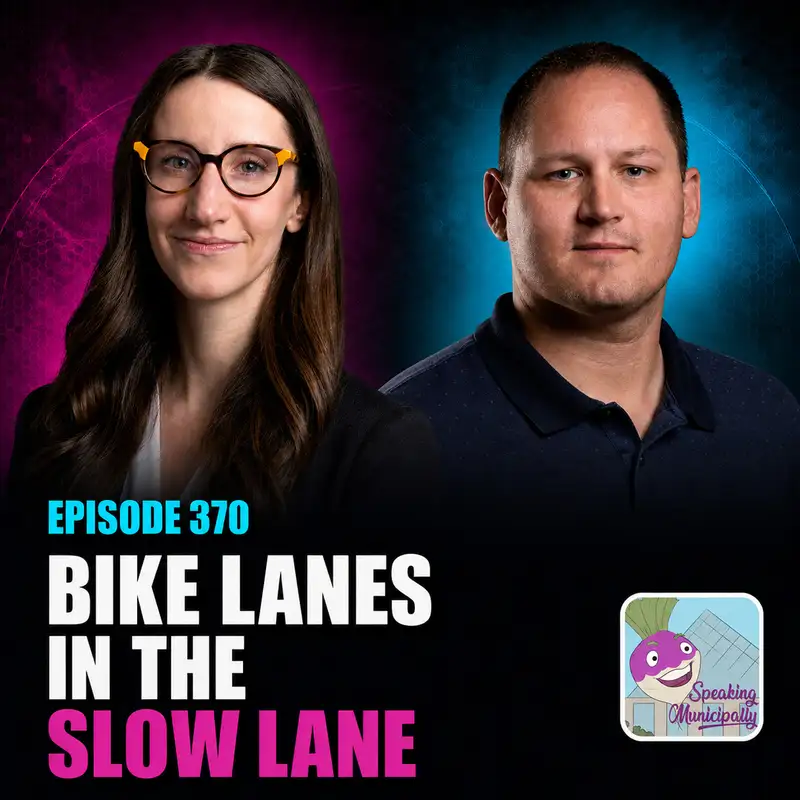
Bike lanes in the slow lane. This week, we speak with Coun. Ashley Salvador and Aaron Budnick of the YEG Bike Coalition about Edmonton's slow bike-lane buildout and the province's threat to derail it. Plus, we hear about the confusing budget of it all and how funding decisions will determine where the network goes next. Hi, I'm Mack, and this is Speaking Municipally. Welcome back to Speaking Municipally, Episode 370. Stephanie is away on her trip, so I'm flying solo today. Well, sort of. Before she left, Stephanie helpfully recorded a very interesting interview, and so that is gonna be the meat of this week's episode. All about bike lanes. It's a good one. But first, I have an ad for you. Do you want to rappel off the side of a building in downtown Edmonton for a good cause? Because apparently that's something you can do. It's the Skyline Rush Challenge, and it's back on October 3 at the Courtyard Edmonton Downtown Hotel. Get strapped in 240 feet up, take in the incredible view of the valley, then rappel down the side of the building, all while raising much-needed funds for Wellspring Alberta and the support it provides to Albertans and families facing cancer. You don't need any rappelling experience. And this year, you can even take on the challenge side by side with a friend. The Skyline Rush Challenge is the only rappelling event in Alberta and one of Edmonton's most unique fundraising opportunities. Ready to do something big for cancer support? Register now at skylinerush.com. Okay, on to the interview. Stephanie recorded this on August 27 with Ward Métis Coun. Ashley Salvador and Aaron Budnick from the YEG Bike Coalition. The interview follows the August 26 infrastructure committee debate, which Colin and I talked a little bit about on last week's episode. The gist of it is administration was proposing making changes to how we build out the Active Transportation Network Expansion, and that is not sitting well with bike advocates. Ultimately, the committee just received the report for information, and Coun. Salvador breaks all of that down. The interview also touches on some really interesting things. You know, we always talk about $100 million for bike lanes, but most of the infrastructure that has been built is not actually bike lanes. I think that's a pretty interesting thing that Aaron gets into. We also hear in this interview about 50 Street, and Coun. Salvador explains why she's the one who wanted to make the change there, even though it seems like it is more of this moving away from what we thought was going to happen around building more bike-lane infrastructure. As a reminder, the province has not introduced any bike legislation. There is nothing that has changed about how we're able to build active transportation infrastructure, including bike lanes, in the city. So that could still come, but we shouldn't be making our decisions based on something that could happen. And you'll hear a bit of that in the interview as well. And then I think the end gets into some really interesting stuff around climate. We're going to talk more about that in an upcoming episode of Speaking Municipally. And, of course, budget and, you know, all of the confusing profiles and where the money comes from and where it's going and the big decisions that are gonna be coming up this fall as council debates the four-year budget. Okay. Over to Stephanie.
Stephanie Swensrude:
Okay, I am here with Ward Métis Coun. Ashley Salvador and Aaron Budnick from the YEG Bike Coalition. Welcome. Thank you so much for joining me.
Aaron Budnick:
No problem. Thank you.
Ashley Salvador:
Thanks so much for having us.
Stephanie:
Awesome. Okay, so we're here to talk about this report that went to infrastructure committee on August 26. There's a lot in there. And, listeners, I recommend that you go back and listen to Episode 368 because we covered that a lot. I won't get into too many of the details. Now we're just here to get these two lovely folks' perspectives on what's in that report. So, the first thing I want to talk about is that the report said the previous council, elected in 2021, chose the rapid approach to building bike lanes and other active transportation infrastructure. Because of that, public engagement was limited and adaptable infrastructure was often used. The report said that this garnered significant negative feedback, and it points specifically to the recent decision to redesign infrastructure on 50 Street, which, of course, we've talked about a lot on the podcast. In that previous episode, Mack said that this is a bit of revisionist history. So, I'll go to you first, Coun. Salvador. Was this an expected outcome back when council approved this in 2022?
Ashley:
So, when it was approved in 2022—and as one of the councillors at the time who was very much in support of this work and really, really drove the conversation around rapid implementation—I think tension is expected, of course. What I think we've seen in the past when Edmonton has tried to build out bike infrastructure is we've done it in a real piecemeal manner. So, we'll build out small segments, and those small segments might be good, but they don't actually get people to where they need to go. And the idea with the rapid buildout was to not only do it in a quicker way, but to actually create a network, and a cohesive, comprehensive network of routes that get people to their destinations safely and efficiently. What comes with that, and where part of the tension comes in, is when it comes to expectations around engagement. The approach that was advanced by council with the rapid implementation, there wasn't an expectation of sort of route-by-route engagement. A lot of the engagement happened when the city did the Bike Plan itself. And, again, that is at the level of a network approach. So, that was around choosing what routes make sense. How do we select the right roads to create that network? And, of course, when designs come out and the neighbours see proposed changes to their street, that can cause some backlash, some frustration, some confusion. But, again, when we're looking to build out a network that is safe and viable for everyone, we have to be looking at that greater good, being able to have a forward-thinking and future-focused approach to the kind of city and transportation network that we're trying to build.
Stephanie:
Yeah. Well, I think that when you talk about the kind of wider engagement with the Bike Plan, I'm really getting déjà vu about the whole Zoning Bylaw Renewal. Because lots of engagement was done for that when it was being built over the years. But then, when it comes to an eightplex or a four-storey building beside your home, it's a very different story, right? Maybe you'd be okay—yeah, bike lanes in my neighbourhood, that's fine. But if it's going right in front of your house and you're gonna lose your parking spot, then all of a sudden you feel as though you haven't been engaged. You know, speaking of that, Aaron, we've spoken about this change on 50 Street. Some may call it a compromise. We talked about it; I don't know if you view it as a compromise. What are your thoughts on this 50 Street change?
Aaron:
Yeah, I think one of the challenges with 50 Street in particular is there was a proposed safe design. And in terms of the type of infrastructure that the bike coalition has been asking for, the original design was a good representation of that. It was unfortunate that some of the parking was going to be removed. It was not particularly well-used parking along that stretch. The city had measured something like 10% utilization, and we went and double-checked that as well. We saw residents in the area double-check it. The number was a little bit higher, but it was generally pretty close. But unfortunately, when we start going to a design where we start moving curb lines and incurring much larger costs, we're now affecting pieces of the network in other parts of the city, most likely, and taking away that network effect that we're trying to build. While potentially increasing safety or decreasing safety—we haven't seen the new designs in the detail that really allows us to answer that question—the legislation that's potentially coming up from the UCP means any delay on a project could mean that it's cancelled, effectively.
Stephanie:
Okay, so this whole Active Transportation Network Expansion—a big, long name for a program—the headline that everyone, you know, heard about back in 2022 was $100 million for bike lanes. And I've always been confused about what exactly that got us, because at first it was like, we're following the Bike Plan, which was, like, hundreds of kilometres of bike lanes. We can obviously see that that has not happened. But then I also know that some are being introduced through neighbourhood renewal, and then some are being introduced through construction in greenfield neighbourhoods, so in new suburbs. So, what exactly has that $100 million gotten us so far? And I guess maybe we'll be going into these recent changes, but yes, what has it gotten us so far? What has been built?
Aaron:
So far, the first year of construction was 2024. In that year, Edmonton completed 3.9 kilometres of entirely shared pathways. So, when we hear $100 million for bike lanes, the coalition generally doesn't consider shared pathways to be bike lanes. They can be used by bikes, but from a safety standpoint, they're definitely not preferable to proper on-street protected infrastructure, a.k.a. what most people would consider a bike lane. Going into the program, Edmonton had 38 kilometres of bike lane. As of where we're at right now, we're at 42. So, we've spent something like $80 million, and we've so far added five kilometres of protected on-street bike lane. On top of that, there's been somewhere in the range of 40 kilometres of shared pathways and local street bikeways, which sometimes look kind of like a shared street—you know, the old ones where there's a bike painted on the cement, but there's not too much else going on. The city has improved its standard there. The new local street bikeways are much better than the old shared streets are. But for a new user, someone who's not super confident on the road, they may not feel very safe, even if they are safe. That perception of safety versus actual safety comes up in a lot of contexts, but it's important to think about for someone who isn't confident on the road. You know, someone like me who is very comfortable riding in almost any type of situation, including on arterial roads, it's fine for me. But someone who's taking their kid to daycare two to 10 blocks away, who hasn't ridden a lot, may not want to do that. Even an experienced rider with a child with them may not want to ride in that context. And there's pretty good research that protected on-street bike lanes feel the safest, and they are the safest, not just for cyclists, but for everybody on the road. So, we've gotten in the range of 50 kilometres total, mostly shared pathways, mostly local street bikeways, and a little bit of protected on-street bike lanes. The ones that were planned for this year, my understanding was there were going to be a lot more on-street bike lanes, unidirectional and bidirectional facilities, with a mixture of other things in there as well. So, we were really looking forward to the 2026 designs to get the bike-lane portion of the $100 million for bike lanes, though the city has never actually called it that. That is more how the media has picked up the name. To the city, it's the Active Transportation Network Expansion, ATNE. So, anything that is walking, rolling, cycling falls into that. And shared pathways are great for a lot of different things. We love them in a lot of contexts. They're great in the suburbs; they work really well. I was just in Rocky Mountain House for some family stuff, and I saw shared pathways all over the place in the rural context, and they worked really, really well there. In an urban context, especially downtown, it's just different. The risk factors are different. There are a lot more users of all types: cars, drivers, cyclists, everything. So, we just need to be careful about using the facility type that is appropriate to the context. So, 2026 was going to be a great year with a lot of great infrastructure. We were really excited.
Stephanie:
Ashley, do you want to weigh in?
Ashley:
Yeah, you know, I will just reflect on the types of installations and infrastructure we've seen so far. Absolutely, there are a lot of shared-use pathways, and I agree with Aaron that, in many cases, that can be good. That's a great option. But I, too, was looking forward to a lot of the on-street facilities. The order that the active transportation team rolled out projects, they've shared that they sort of did the, I'll say, low-hanging fruit first, or the easier routes first. And we're getting into some of the more complex ones. And when I look at even Ward Métis, we were expected to get a lot of that infrastructure this construction season, which was why it was concerning to see the report come forward to committee that we just discussed yesterday that potentially looks at re-evaluating a lot of those projects. These are routes that have, in some cases, been planned for many years. I look at the Bonnie Doon network. Council actually approved that in 2021 as a sort of network and connection of routes that needed to be prioritized. There's high potential for ridership in those particular locations. There's a desire from residents to see safe, protected infrastructure. So, to see that that was potentially going to be re-evaluated was very concerning. And, yeah, I was pleased that committee arrived at the decision to continue with implementation. But, again, I would like to see those moving faster than we have been moving.
Stephanie:
Well, speaking of committee, speaking of what happened at committee this week, there's a lot to get into, kind of talking about transparency and everything. Yeah, I don't even know where to start, basically. This report came out that, to me, my perception was administration has proposed pausing planned active transportation infrastructure that takes away parking spaces or vehicle travel lanes. And then a new, updated attachment came out that still kind of said the same thing, but then the city manager was there saying, no, we're not cancelling anything. So, I was really confused. Maybe, Coun. Salvador, can you walk us through what's happening? What is going on?
Ashley:
Yeah, I shared in that confusion. When I saw this report coming forward, council direction has been very clear that we are continuing with the planned active transportation rollout. So, to see this come forward from administration that, to your point, Stephanie, would essentially pause a significant number of routes and re-evaluate them was alarming for me, and I know for a lot of community members as well. There were revisions to attachments, but fundamentally, I still read them the same way: that they would result in pauses and re-evaluations. At committee, administration did share some clarifications that the intention is not to cancel routes, but from my perspective, if we are providing so much weighting towards parking and towards travel lanes, that potentially comes at the expense and viability of being able to put in protected active transportation infrastructure, which in many cases, when we're looking at constrained roadways in existing communities, will make those projects just not viable at all. So, that was my read of it. There were a number of rounds of questions. We heard from about 60 speakers, many of whom shared their support for active transportation and desire for these routes to continue. After those back-and-forth questions between council and administration, I actually moved a motion just to be crystal clear that the intention is to continue expanding our active transportation network in accordance with previously approved council direction—so, essentially rejecting what administration was proposing. I was also hoping to get direction in there around immediately advancing procurement for all of the tender-ready routes that are essentially ready to go. I also was hoping to get going on some partial construction. I would like to see infrastructure in the ground. Some of the installations that we're talking about, in many cases, are actually just traffic calming. We were talking about the different types of infrastructure, and Aaron mentioned local street bikeways, for example, where we're essentially putting in kind of traffic barriers—or modal filters, is what they're called—to calm down traffic, slow folks down, still allow active modes to pass through, but really try to prevent shortcutting and speeding in our communities. I feel that that infrastructure should be able to go in sooner and quicker than we've been seeing. So, that was my intention: to advance that and also provide direction that we are ready to go come spring, so that any routes that are planned for early 2027, we can start construction sooner than we've been seeing in previous years. Because at this point, unfortunately, we're seeing projects now just completed that were supposed to be done last season. So, there has been a delay with late tenders.
Stephanie:
And, you know, the city has quietly cancelled or delayed several projects. I only learned of this a few days ago, and maybe I need to reach out and learn more about what's happening. But it says on the Active Transportation Network Expansion page that Grovenor, Terrace Heights and the route along 95 Avenue in the west end are all delayed or deferred. Grovenor has been cancelled because of feedback due to parking and traffic. And I would say I'm a pretty in-the-know person, and I had no idea about this until recently. So, it seems as though the city is, like, deprioritizing routes that take away parking and traffic lanes.
Ashley:
Yeah, and I think that's a fair question, a very fair question. Administration does have a degree of delegated authority to make some adjustments and tweaks to routes based on feedback, based on what they're hearing, based on their expertise, et cetera. But, again, I think that's why this was an important conversation: to be very clear around what the expectations are from council around the criteria that we're using when we are continuing to build out bike infrastructure, and that heavily weighting parking and travel lanes at the expense of active transportation is not the intention.
Stephanie:
Yeah, and I think I will push back on this a little bit, Coun. Salvador, because, I mean, you did move a motion on the 50 Street redesign to preserve parking and travel lanes. How do you square that?
Ashley:
Yeah, 50 Street is, from my perspective, a unique situation. So, we're talking about a roadway that was actually a former highway connection. There was supposed to be a bridge that went over the river on 50 Street. So, it's a four-lane arterial roadway with about a 10-metre-wide centre-running median. It's one of the few—potentially, yeah, maybe one of two roadways in the entire buildout—that is an arterial roadway as well. I found out that there actually was an alternative design that was available that does accommodate protected active transportation, parking lanes, as well as driving lanes. So, in this case, I felt it was reasonable to accommodate all of those modes while still moving forward on the vast majority of routes that do take away, in some cases, parking, in some cases, driving lanes. I always say I'm not a stranger to navigating those conversations with community, and I was very clear in that 50 Street conversation that I expect to continue doing that, and I expect the infrastructure that is planned to continue forward, even if that does mean eliminating parking or driving lanes. The other unique piece about 50 Street—and not to get into too many details—is the roadway itself is of two vintages. So, one part of the roadway is due for full-scale renewal; the other part is not, because it was done at a later date. So, the portion that is due for renewal is very likely going to have driving, parking and protected bike infrastructure when it is fully torn up and redone. What this allows us to do is to ensure that there's a contiguous and continuous piece of infrastructure that actually matches up with one another.
Aaron:
So, on 50 Street, about Coun. Salvador's motion, it was not necessarily the outcome that we wanted to see, but we always appreciate when elected representatives hear from their constituents and take action to bring that forward to council for a discussion. We obviously didn't want to see the motion pass, not because we want parking removed at all costs, but because we really do think that, in this case, delay is probably cancellation with the impending legislation. But that is a spot where we can fit parking, driving and a good-quality bike lane all in the same spot. And it's great that we can make that happen. Hopefully it does go through. But, you know, we always appreciate seeing councillors bringing forward concerns from residents to council so that a public conversation can happen. That transparency is important.
Mack:
We'll have more from Stephanie's interview with Coun. Salvador and Aaron Budnick in just a moment. This episode is brought to you by Life Sciences Week, a free, community-led event that celebrates and advances Alberta's life sciences. I had the opportunity to speak recently with Andrew MacIsaac, CEO of API, the organization behind Life Sciences Week, about the impact of the event on the Edmonton region. Here's Andrew.
Andrew MacIsaac:
The life sciences sector is something that has grown dramatically, even over the past few years. And to just take it back a little bit, life sciences means pharmaceuticals, medical devices, diagnostics, natural health products—all the sorts of technologies that go in to improve people's quality of life and save lives. And it's a sector that we have a huge amount of expertise in around the Edmonton metro region. The U of A has many, many fields that are ranked in the top 100 in the world in it. Some of them are in the top 10. And it's an area that, you know, if you're looking at it from a provincial standpoint, back in 2018-ish, the sector was about $750 million in economic output. Now it's close to $5 billion. So, the growth of a sector like that so quickly is something that really shows that we've got the fundamentals here. We just haven't really been aligning all the pieces together. And so, one of the reasons to launch Life Sciences Week is to give it an opportunity to actually showcase this sort of not-as-talked-about side of the industry and the sector that will hopefully be the place where many, many grads from our post-secondaries in the region go to work, and where we start to see a large amount of diversification into building on the other sectors that we have in the province, like the petrochemical industry or the value-added ag side.
Mack:
Life Sciences Week runs September 21 to 25, with events across the province. The kickoff is right here in Edmonton at 10 a.m. on Monday, September 21. You can learn more and check out the full calendar of events at lifesciencesweek.ca.
Stephanie:
You mentioned the provincial legislation coming up, and that was kind of the spectre hanging over the report and the whole committee meeting. Lots of people who came to speak at the meeting mentioned this upcoming legislation. I believe you probably talked to it too, Aaron. What did you say, and what did you also hear from the other speakers who came out yesterday?
Aaron:
Yeah, I tried to keep my speech pretty straightforward: that we support ATNE. We want it to go forward. Anything that was supposed to be built in 2026, we wanted to see finished in 2026. There's definitely more we could talk about on that piece in particular. And in the next budget, we want to see a project like ATNE continue on because, like Coun. Salvador had said, we're mostly adding bike lanes through Building Great Neighbourhoods, the neighbourhood renewal projects. And that doesn't leave a lot of gaps, and there are a lot of opportunities to take existing bike lanes that are substandard, older designs and upgrade them to more modern, safer standards. So, that was what I said. I heard from a lot of people who were concerned about the legislation that's coming, a lot of people who really are concerned about safety. You know, we've been a Vision Zero city for 10 years now. We are seeing the worst results. Last year was the highest number of traffic deaths on our streets, I think ever, but certainly since we declared Vision Zero, and the line is going in the wrong direction right now. Bike lanes are an important way of improving traffic safety—again, not just for cyclists, but for everybody on the road, including drivers. And that has to be a top priority of the city in everything that we do. And that is central in our advocacy.
Stephanie:
Yeah, I heard the term "anticipatory obedience," and I think someone quoted historian Timothy Snyder, who said that it can be defined as individuals who think ahead about what a more repressive government will want and then offer themselves without being asked. "A citizen who adapts in this way is teaching power what it can do." And, you know, some of the speakers were saying that we should be doing more before the province comes in and takes the bike lanes away. Coun. Salvador, what do you think about that term, anticipatory obedience?
Ashley:
Yeah, at this point, we don't actually know what the legislation is gonna look like exactly. We have heard rumblings, of course. We've heard what's been shared publicly by the minister. But until there is firm legislation in place, I think we need to continue as planned. And we heard that not only from speakers, but from councillors and colleagues yesterday as well, reaffirming that this is critical work. We are looking to build a city that is safe and viable for everyone, regardless of how they choose to get around. We know that we are seeing more traffic fatalities and injuries on our roadways, and continuing to build out what is a known and evidence-based tool to protect people is critical. I also think about the tools that we've been stripped of, like photo radar, and the consequences that we've seen because of that. I hear regularly from community members that I represent about people who are driving dangerously through their communities, people who are speeding. We've seen the data and the numbers around the number of fatalities on our roadways since the removal of that. So, we need to be looking at more tools, not less. So, it's deeply concerning to see the provincial government stepping into this space and potentially taking that away from us.
Stephanie:
So, after you heard from all those speakers and everything—a long day of hearing from folks on both sides of the debate, also, I will say; I would say that the people who were more pro-bike lanes definitely outnumbered anti-bike lanes—but anyway, after you heard from all the speakers, Coun. Salvador, you made a motion to try to give this explicit instruction to move forward. That did not pass. And then what happened was the report was received for information. This is very jargony, listeners, but basically, what does it—in this case, what happened next? Because I think that there was a possibility that committee could have made a recommendation for a different course. Coun. Salvador, can you explain what receipt for information meant in this case?
Ashley:
Yeah. So, the recommendation that administration put forward was to adopt their modified approach that was based on parking and driving lanes, and to re-evaluate a significant number of routes. Council said no to that, essentially, is what happened. So, by just receiving the report for information and not actually adopting the recommendations in the report, it says continue as planned. So, that is the action that was taken. From my perspective, again, I was hoping to be crystal clear and explicit around continuing as planned, with a slight, I would say, acceleration around procurement timelines. That did not pass, but administration very clearly articulated back to committee that they are going to be continuing with the routes as planned and not shifting to their alternative approach.
Stephanie:
Okay, cool. And then, later on at, like, 9 p.m., you made a notice of motion for something that will be introduced next week. And this was related to funding that will come up in the next budget deliberations that are gonna be happening in a few months here. Can you tell me about that motion?
Ashley:
Yeah, so I made a subsequent motion that basically says, if we need additional funding to make sure that this work gets completed, please bring that back to us so that we can continue this work and we can continue the momentum that we've built. It was a two-parter, so that was part one. And then the second half was future-focused, saying we're not done building out our network. This was sort of the first phase of implementation. How do we keep going from here? So, it's asking for options to come back during our budget conversation so that we can adequately fund this work going forward.
Stephanie:
Right. So, that actually segues really well into another question I have here. Another report that was released recently is the city's climate priorities, which—it's a very interesting report. I wish that we could get into all that, but we do not have time. It's just fascinating to me. But essentially, the report says the first priority—which, all of this has to be approved by council—but the first priority is to establish an ongoing and accountable relationship with Indigenous Peoples regarding climate. And then, after that, the remaining priorities are divided into the following categories: one—or, I guess, two—buildings and land use; three, transportation; four, infrastructure; five, nature and water; six, low-carbon energy and waste. So, what I thought was really interesting about this is that the first two after Indigenous relationships are buildings and land use, and transportation. And then under that transportation heading, the first two are to improve transit and expand the active transportation network. So, all of that is to say that these new climate implementation priorities put transit and active transportation as a high priority. Now, the report says that it would cost $30 million to build new priority walking, cycling and rolling routes, establish bike-parking standards, and build high-priority bike parking. Do we know if that $30 million is going to be included in the proposed budget? Is that kind of what your motion was about?
Ashley:
We don't know exactly what's going to be included in the proposed budget at this point. But those are the kind of details that I really would like to get a handle on. And I expect that when I make this motion, we're gonna be able to have that conversation. Because there are a few things here, right? There's closing missing links, there are end-of-trip facilities, there's improving existing substandard routes, but then there's also genuine expansion of the network itself. And I wanna have a better understanding of where those buckets fall and what dollar amount is being allocated to each, so that we can not only improve existing routes and ensure that all the supporting factors around having a strong network are in place, but that we're actually continuing to expand that network. Yeah, I was also just gonna reference the importance of continued buildout when it comes to climate action. We know that land use and transportation are two of the biggest contributors to climate change. And within land use, I always say kind of there are a few prongs. There are buildings, from more of a micro land-use perspective, but then there's also the way that we build out our cities. Edmonton is a very sprawling city. It is a very auto-centric, car-dominated city. And by the nature of being so spread out, we are quite auto-centric and have high emissions. So, absolutely, building out a more complete and connected bike network, as well as a public transit network, is a critical part of turning the dial on emissions. But, to your point, I absolutely want to get a clear understanding of what administration is intending to bring forward and how we can close any of those gaps to ensure that we're continuing momentum on this work.
Aaron:
So, there's $30 million for active transportation buildout in the climate strategy. There's the Bike Plan Implementation Guide, which is what funded the $100 million in the last budget cycle. In the next budget cycle, it will be called the Active Transportation Implementation Guide. We understand that that's about $30 million that admin is going to be asking for, and that's due sometime in Q3. But we've not seen all the details yet. It's coming soon. And then there's Building Great Neighbourhoods, which sometimes builds active transportation infrastructure, but we don't know what the budget ask or profile is going to be for that particular project. So, we've got all these budget asks that are in a lot of different places. And it's unclear if that's the same $30 million just being referenced in two different places, or if it's two different $30-million buckets that would be doing different things, and how those all fit together. So, obviously, budget is going to be very interesting when we get to that, but there are a number of asks for cycling or active transportation or safety-related things that all need to interact with each other and work together. It's not super clear if all of those people within admin are talking to each other. Presumably they are. Hopefully they are. But we do sometimes hear rumours that they aren't always, so it is curious. And I guess there's a lot of lack of clarity about how well all of these different programs will work together, not interfere with each other, and go from, you know, a pretty strategy on a piece of paper to effective implementation. Because I think we see that with the climate strategy. It's a great document. That's awesome. We're failing it and we're falling behind. Vision Zero is a great strategy, an excellent document. We're falling behind. The Bike Plan is great. Implementation has been problematic. There does seem to be a gap at the city between writing strategies and setting lofty goals and actually executing on that. And I don't know if there are any conversations going on about how to close that gap, because great strategies are nothing if we can't execute on them.
Stephanie:
Yeah, you know what they say, like, a city's—what is it? Like, a city's values aren't in its plan, they're in its budget. Like, it's in what actually gets built. Okay, so I wanted to talk a little bit, ask Aaron about some activism and events that you have coming up. I saw something about a Week Without Bike Lanes. I thought you wanted bike lanes. What's going on?
Aaron:
What we're planning to do for next week, so August 31 to, I think, September 6, is encourage people who feel comfortable and feel safe in the context of their trips to spend the week using the same routes that they would normally use, but not to use the bike lanes that they're on. And the purpose is to help everyone in the city understand what it would look like if the province did come in and remove bike lanes. So, we're encouraging people to follow the law—you know, stop at all the stop signs, yield to pedestrians. If you're riding in groups, ride single file, all that sort of thing. But just make it super clear what the impacts of not having bike infrastructure would be on drivers and other people in the city. I think it's important for us to remember that we've been building bike infrastructure in a meaningful way for about 10 years in Edmonton. In that 10 years, the city has grown by, what, four Red Deers or something to that effect. We have seen a huge increase in cycling across the city. And there are a lot more people driving as well, and that's creating a lot of traffic. What used to work, the vehicular cycling, the John Forester approach, which is now largely discredited, only worked for the people who felt comfortable on the road and didn't broadly work for a huge number of cyclists. If we go back to that sort of a model, we're either going to see people stop cycling and get back in their cars—and that's more people in traffic, slowing everyone else down—or we're going to see cyclists having to mix with traffic, which will also slow people down. A bike can go as fast as a bike can go, and there's just no way around that. If there's no space for cyclists, we have to share lanes with drivers. So, this is not a Critical Mass protest of any kind. We're not breaking any laws. And we want to be very clear: if you are participating, do not break the law. But we do want to make it super clear what that would look like if the province got its way.
Stephanie:
All right. In the last few moments here, you know, Coun. Salvador, what are you thinking after this report, heading into budget, potentially having to deal with this legislation from the province? How are you feeling? What are you thinking about? I know it's kind of a big question, but just any last thoughts on what we've talked about today?
Ashley:
I'm reflecting on what we heard from speakers at our conversation yesterday, and I'm reflecting on people who shared the freedom that they get to experience when they have access to safe, protected bike infrastructure, hearing about how it has unlocked the city for them. It has enabled them to move around in more affordable ways, safer ways, more joyful ways. And I sort of contrast that with other folks who shared that they would love to be able to experience that too. And I think about all the times that I've been knocking on doors where people will say, I would love to be able to bike, but I don't feel safe. I would love for my kids to be able to bike to school, but they don't have safe infrastructure to do so. And it just really underscores for me the importance of continuing this work. And, yeah, I think there's just so much potential for Edmonton to continue building. And I think it would be absolutely devastating if we're not able to do that because of provincial interference and legislation that ultimately makes our communities less safe. I think, for a level of government that has continually talked about overreach and has shared their concerns, it is wild to me to see that that is happening at the municipal level. Yeah, so, again, at the end of the day, work needs to continue. Our communities deserve safe infrastructure. That's something that I'll continue pushing for, and it's good to see that council has reaffirmed that commitment at our most recent meeting.
Stephanie:
And, yeah, Aaron, any last thoughts that you wanted to share?
Aaron:
I think it's important to point out that building bike infrastructure, or bus rapid transit, or public transit generally, is not a "war on cars," quote-unquote. This gets, you know, bandied about quite often. Putting a bike lane in, even if it's right in front of your house, is not anyone trying to force any particular user to get out of their car and do something else. It just gives options. Some people want to take those options, and when people take those options, that typically results in less traffic congestion for everyone else. If we want lower taxes, bike lanes can help. If we want less traffic, bike lanes can help. If we want healthier cities, bike lanes can help. If we want more freedom, bike lanes can help. They're a really great way to help us achieve many of the goals and address the hard problems that the city is currently facing. And, again, we're not forcing anyone out of the car. If you want to drive, that's great. We have no problem. If you need to, if you want to, if you prefer to, no problem. But everything is getting really unaffordable. After housing—you know, rent or mortgages—driving is the most expensive thing in most households. And being able to just reduce by one car and get around a little bit more by bike—it's fun to ride a bike. It's super social. You're gonna run into people all the time. It will change your life in a way that is hard to predict if you're not actually out on your bike and doing it. And we want everyone who wants to experience that to have the option, and most people will benefit even if they themselves never get on a bike.
Stephanie:
Okay, well, thank you so much. As always, I always say this, but I could have talked for, like, two hours about this. But thank you so much for sharing your insights. We will definitely be watching here on Speaking Municipally to see what happens next with all of this. And, yeah, thank you so much.
Aaron:
Thank you.
Ashley:
Thanks so much.
Mack:
All right, there you have it. Coun. Salvador's subsequent notice of motion came up only very briefly this week. At the September 2 executive committee meeting, she gave notice that she intends to bring it up at the next council meeting, which is after the long weekend, on September 8. So, we'll keep an eye on that and bring you updates as we have them. That's it for this week. We'll be back with another episode of Speaking Municipally wherever you get your podcasts next week. Until then, I'm Mack.
Stephanie:
I'm Stephanie.
Ashley:
I'm Ashley.
Aaron:
I'm Aaron.
Stephanie:
And we're…
All:
Speaking Municipally.
Creators and Guests